


The IntuiWeb Blog Opinion
100% AI websites: the free offer trap that could cost you dearly
Build your website with AI, yes. Hand it the keys to your business? That is another matter.
This week, Anthropic, the company behind Claude, made its Nasdaq debut. It is the biggest stock market listing in history. The shares opened 34% above their offer price, and the company is now worth around $2 trillion. We can applaud the achievement. We can also ask a simpler question, one that every small business owner, tradesperson and independent professional should ask before entrusting their website to artificial intelligence: who will pay for that $2 trillion?
The answer is one word: you. Not today, not immediately, but tomorrow, almost certainly. And it is precisely when you have built your business around these tools that the bill will arrive.
AI-driven CMS platforms are multiplying, and they really are appealing
In recent months, a new generation of website builders has flooded the market. Describe your business in three sentences and an AI agent generates the pages, writes the copy, chooses the colours, takes care of search visibility, and your site is online before you finish your coffee. Established platforms are following suit and now describe themselves as “AI-native”, with agents handling optimisation for answer engines and AI credits included in every subscription.
It has to be said: it is impressive. Today, anyone can ask Claude, ChatGPT or Gemini for a complete web page and receive it in seconds, without knowing anything about graphic design, web design or SEO. For anyone who has wrestled with an old-fashioned website editor, it feels almost magical.
But that magic comes at a price, and they are not showing it to you yet.
Free AI does not exist; it is simply subsidised
Running an AI model costs a fortune: data centres, graphics chips, electricity and engineers. The big American labs are spending staggering amounts without yet demonstrating sustainable profitability. If you currently pay just a few euros a month to generate an entire website, it is because somebody else is paying the difference. Investors are financing the race to capture the market.
Now that these companies are listed, or preparing to be listed like OpenAI, the logic changes. Shareholders will not fund losses forever; they expect a return. To justify valuations in the trillions, there is only one solution: increase revenue per customer. The first signs are already here. In 2026, several website-building platforms revised their prices, introduced AI credit quotas and added usage meters. Some Squarespace customers publicly protested against increases they considered abrupt. This is only the beginning.
The scenario that should worry you: €1,000 to change a page
Take a tradesperson in Finistère who builds a website this year using a CMS entirely driven by AI. Everything goes through the agent: layout, text, structure and SEO tags. They do not know where the code is, cannot export it and, in any case, would not know what to do with it. Their website exists only within the platform and can only be edited by talking to the AI.
Three years later, the platform changes its terms. Included credits shrink, every generation becomes chargeable, and the AI model moves to a “premium” tier. A simple redesign of the pricing page, which used to take ten minutes, now consumes a mountain of credits. Overall, the annual bill has tripled, and a complete redesign costs as much as hiring an agency.
Can our tradesperson leave? In theory, yes. In practice, their website exists nowhere else, their content is locked into a proprietary format, and nobody around them knows how to take over what an AI agent assembled inside a black box. They will pay. They have no choice.
That is the real danger. It is not AI itself, but AI becoming the one and only way to act on your own business tool. First comes the need, then usage, then dependence. Once dependence is established, the supplier can set whatever price it likes.
The giveaway strategy: a familiar scenario
There is nothing new about this model. Chinese industry applied it spectacularly to solar panels: prices so low that almost all European manufacturers disappeared, leaving Europe almost entirely dependent on a handful of suppliers. The same mechanism is emerging in electric vehicles, with models sold at prices that undercut all competition. Many economists see a classic predatory pricing strategy: sell at a loss until competitors are eliminated, then regain control over prices.
AI is following the same path. Highly capable Chinese open-source models, distributed free of charge, are spreading around the world. American giants, meanwhile, offer very generous entry-level plans. In both cases, free access is not a gift; it is an investment. And an investment must deliver a return, sooner or later.
This is not to say that all these companies will necessarily send prices soaring. It is a reminder of an obvious fact that technological fascination can obscure: if your business depends entirely on a single supplier, that supplier sets the rules.
A website without skills is also a website without control
Money is not the only issue. A website produced entirely by AI, by someone with no understanding of the subject, also raises a question of control. If you do not understand why the agent chose a particular heading, tag or page structure, you can neither check nor correct it. Yet AI makes mistakes: it invents information, standardises designs until websites all look alike, and applies generic SEO formulas that take no account of your catchment area, customers or competitors.
Search visibility, in particular, is not simply an automatically generated list of keywords. It is a strategy. If that strategy is completely beyond your control, you are handing your visibility—and therefore your revenue—to an algorithm you do not control and that belongs to somebody else.
Use AI without becoming its slave
Does that mean we should stop using AI to build websites? Of course not. That would mean giving up an extraordinary accelerator. The right question is not “AI or no AI”, but “who stays in control?” A good tool for tomorrow lets you benefit from AI when it helps, and do without it when it becomes too expensive or when you simply want to do things your own way.
In practice, this comes down to three conditions. Your website must genuinely belong to you, in an open format that can be exported and hosted wherever you choose. Every AI proposal, whether about design, content or SEO, must remain a suggestion that you can read, understand and change at any time. Finally, the tool must not be tied to a single AI model, so you are never held hostage by one supplier’s pricing policy.
IntuiWeb by Cymadiau: AI serving the user, not the other way around
That is exactly the philosophy behind IntuiWeb, the website editor developed by Cymadiau, whose official release is scheduled for 1 December 2026. IntuiWeb can draw on AI, but it never locks you into it.
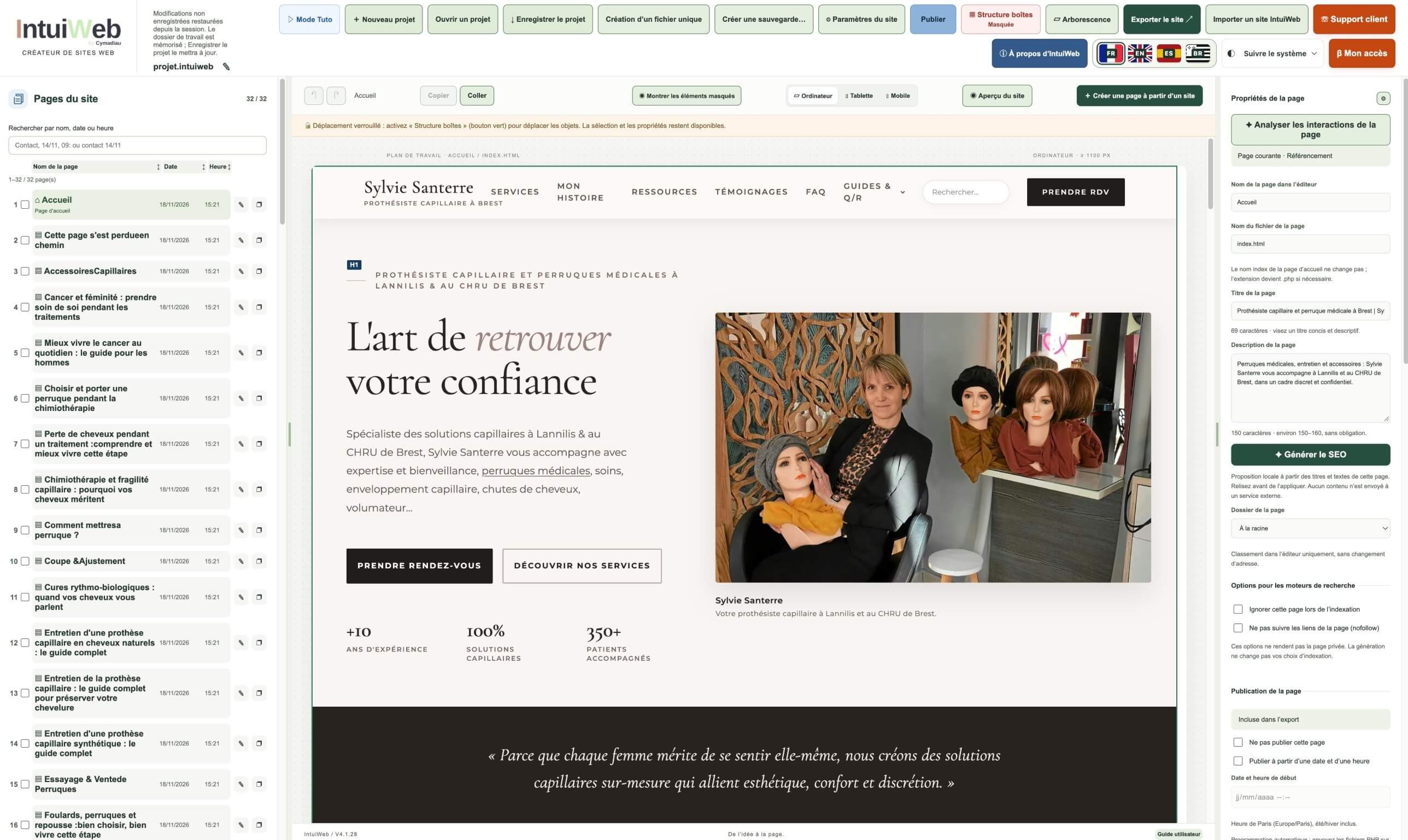
Your projects stay with you, locally, on your own computer. Your website is exported as standard HTML, and you host it wherever and with whomever you choose. If the tool disappeared tomorrow, your website would remain online, readable and editable by any web professional. No black box, no hostage situation.
Search visibility follows the same logic. If you are unfamiliar with it, IntuiWeb offers a solid starting point for your titles, descriptions and page structure, along with optimisation for visibility in AI answer engines. But every element remains visible and editable at any time. You learn as you go, make corrections whenever you want, and stay in charge of your strategy. The same applies to design: it belongs to you and does not depend on an agent deciding on your behalf.
When it comes to AI, IntuiWeb chooses openness. Its archive format is documented, so any artificial intelligence—American, Chinese or European—can generate a website that imports directly into the tool. You choose your AI and can change it whenever you wish. An integrated AI assistant powered by France’s Mistral AI is also planned for the first quarter of 2027 in the rental version: a choice of digital sovereignty rather than another dependency on American giants.
Then there is the business model, perhaps the most decisive argument. IntuiWeb is available as a lifetime purchase, starting at €129 including VAT for the Personal licence, or as a rental at €7.90 including VAT per month. The price is known in advance, it is fixed, and no credit balance drains with every edit. Changing your pricing page will never cost more than the time you spend doing it.
Tomorrow starts today
Anthropic’s stock market listing marks the end of an era in which AI was presented as an almost free service available to everyone. Another is beginning, in which colossal investments must be made profitable. Businesses that have staked everything on closed tools entirely controlled by AI agents risk discovering the true cost of convenience at the worst possible moment.
The right approach is simple: make the most of AI, but never hand it the keys to your house. Choose tools that leave you the owner of your website, in charge of its design and in control of its search visibility. AI should remain a brilliant assistant, not a landlord who raises the rent every year.